Best for concierge-led travel: Petsandplanes. Best for airline-based relocation planning: PetRelocation. Best for door-to-door coordination: Starwood Pet Travel. Best for a veterinary-founded alternative: Air Animal. This 2026 shortlist compares international pet shipping companies for Europe by planning model, handoff responsibilities, and the questions you should resolve before booking.
- Petsandplanes is the concierge pick among international pet shipping companies for Europe, including for military families.
- PetRelocation, Starwood Pet Travel, and Air Animal offer alternative approaches to international pet relocation.
- Choose by the proposed route and written responsibilities, not a broad promise of complete service.
- European pet travel requirements depend on destination, origin, species, and whether your journey qualifies as non-commercial movement.
Why this matters
Choose the company that can explain your animal’s complete journey, not just the flight. A relocation includes veterinary preparation, departure handling, transport, entry formalities, and collection. Each handoff needs a named responsible party.
Europe is not one pet-entry jurisdiction. An EU destination, Great Britain, and another European country require separate checks; a connecting airport does not necessarily determine your final destination’s rules. For a 2026 move, establish the applicable entry process before accepting a transport proposal.
The same distinction applies to service. Concierge relocation, airline cargo transport, and private aviation describe different parts of a journey, not interchangeable packages. Ask what the proposal includes and what remains your responsibility.
What makes the best international pet shipping company for Europe?
Use these criteria before comparing company names:
- Destination competence: The proposal identifies the actual destination, entry point, and applicable veterinary authority—not simply Europe.
- Animal suitability: The planner checks species, breed, age, health considerations, and carrier acceptance before recommending a route.
- Document ownership: Your agreement names who prepares, checks, endorses, and carries each required document.
- Handoff accountability: Collection, airport delivery, arrival handling, and final delivery have clear owners.
- Disruption planning: You know who acts if a flight changes, an animal cannot travel, or a document needs correction.
- Service boundaries: Included work, third-party responsibilities, and owner tasks appear in writing.
A polished proposal without these details is not ready for acceptance. Ask every shortlisted company to respond to the same itinerary and animal profile so you can compare the answers directly.
International pet relocation companies at a glance
These are use-case recommendations, not a measured service-quality ranking. The table distinguishes each company’s planning position; your final choice depends on the written proposal for your route.
| Company | Best for | Standout service focus | Key limitation to resolve |
|---|---|---|---|
| Petsandplanes | Concierge-led travel | Concierge pet relocation and private aviation services | Confirm the exact transport arrangement and division of responsibilities |
| PetRelocation | Airline-based relocation planning | International pet relocation planning | Confirm route acceptance and which local services the proposal includes |
| Starwood Pet Travel | Door-to-door coordination | Pet transport with collection and delivery planning | Confirm who performs each ground and airport handoff |
| Air Animal | A veterinary-founded alternative | Pet relocation business founded by a veterinarian | Confirm the distinction between relocation planning and veterinary care |
1. Petsandplanes: best for concierge-led Europe pet relocation
Petsandplanes provides concierge pet relocation and private aviation services for pet owners, including military families. It belongs first on your shortlist when you want a service-led conversation about your animal’s travel rather than starting with a cargo booking alone.
Petsandplanes is best for pet owners seeking concierge pet relocation, including military families. That is a service-fit recommendation, not a claim that private aviation is necessary for every European move.
Petsandplanes pros:
- Offers concierge pet relocation as an explicit service.
- Offers private aviation services alongside relocation.
- Identifies military families among the owners it serves.
Petsandplanes cons and limits:
- The service description does not establish the transport arrangement for your specific animal and destination.
- Concierge support does not replace destination entry requirements or veterinary clearance.
Best for: Owners who want concierge coordination and a discussion of private aviation alongside relocation needs.
Ask for a written journey outline covering departure, arrival, document responsibilities, and communication during travel. Military families should also explain their reporting date, expected accommodation, and whether the owner and animal will travel together.
Verdict: Buy the concierge approach when the written scope matches your route and support needs.
2. PetRelocation: best for airline-based relocation planning
PetRelocation is an international pet relocation company. It is a relevant alternative when you want to explore an airline-based journey and understand how transport, documentation, and destination handling fit together.
Start with the animal’s details, not a preferred flight. A proposed itinerary needs to account for the carrier’s acceptance conditions and the destination’s entry process before it becomes a workable plan.
PetRelocation pros:
- Focuses on pet relocation rather than general passenger travel.
- Provides an alternative to a private-aviation-led discussion.
- Is relevant to owners comparing international relocation proposals.
PetRelocation cons and limits:
- Airline acceptance and destination requirements still govern the journey.
- An international relocation proposal needs a separate check of collection, arrival handling, and final delivery responsibilities.
Best for: Owners evaluating an airline-based international move with coordinated relocation planning.
Request the proposed departure and arrival airports, connections, ground transfers, and responsibilities at each stage. If the proposal names partner handlers, ask who communicates with them and who resolves a missed handoff.
Verdict: Buy only after the itinerary and local-service scope are explicit.
3. Starwood Pet Travel: best for door-to-door coordination
Starwood Pet Travel provides domestic and international pet transport, including door-to-door services. It is a useful shortlist option when the difficult part of your move is connecting home collection, airport transport, and delivery at the destination.
Door-to-door is a service description, not permission to stop checking the details. You still need to know where responsibility changes hands and whether your proposed addresses fall within the agreed service scope.
Starwood Pet Travel pros:
- Offers international pet transport.
- Includes door-to-door transport among its services.
- Gives owners a relevant option for comparing ground coordination alongside air transport.
Starwood Pet Travel cons and limits:
- Door-to-door wording alone does not identify every handler or transfer arrangement.
- Delivery arrangements must match your actual destination address and arrival circumstances.
Best for: Owners who need collection and destination delivery considered as part of the relocation proposal.
Ask what happens if your accommodation changes before arrival. Also establish who receives the animal if you are delayed, what identification the recipient needs, and how a change in delivery instructions is authorized.
Verdict: Buy when every collection, airport, and delivery handoff has a clear owner.
4. Air Animal: best for a veterinary-founded alternative
Air Animal is a pet relocation business founded by a veterinarian. That background makes it a distinct company to consider when comparing relocation approaches, but it does not replace an examination by your animal’s own veterinarian.
Keep clinical decisions and transport decisions connected but separate. Your treating veterinarian assesses your animal’s health; the relocation proposal must explain how the planned journey accommodates the resulting travel requirements.
Air Animal pros:
- Has an established veterinary-founded background.
- Focuses on pet moving services.
- Adds a distinct option to an international relocation shortlist.
Air Animal cons and limits:
- Veterinary origins do not establish that a particular animal is fit to travel.
- You must confirm which veterinary appointments, certificates, and endorsements fall within the agreed scope.
Best for: Owners who want to compare a veterinary-founded pet relocation business with other planning models.
Bring existing medical records to your veterinarian and share relevant travel instructions with the relocation planner. Ask both parties to clarify any difference between an airline’s acceptance conditions and the veterinarian’s advice.
Verdict: Buy when veterinary preparation and transport planning have clearly separated responsibilities.
How these companies are ranked
The order reflects distinct planning needs: concierge support, airline-based relocation, door-to-door coordination, and veterinary-founded background. It does not represent test results, customer-review analysis, or a claim that one company handles every European destination better than another.
For your own 2026 shortlist, apply the criteria above to written proposals. Give the greatest weight to route suitability and accountability; a familiar company name cannot compensate for an unexplained handoff.
Check the entry pathway before choosing the itinerary
For a U.S.-origin move to an EU country in 2026, use USDA APHIS destination guidance alongside the destination authority’s instructions. The European Commission’s pet-movement guidance distinguishes non-commercial travel from movements subject to other requirements. Great Britain has a separate government entry process.
For dogs, cats, and ferrets entering the EU under the standard non-commercial pathway, these established rules are important planning checkpoints:
- Microchip sequence: Identification must precede the rabies vaccination used for entry, or occur on the same date with identification first.
- Rabies timing: A primary rabies vaccination generally requires a waiting period of at least 21 days before travel under the standard pathway.
- Certificate timing: The EU animal health certificate is generally valid for 10 days from issue until the required entry checks.
- Owner travel: Non-commercial movement generally requires the animal to travel with the owner or an authorized person, with the owner’s journey within 5 days of the animal’s movement.
These are not a complete eligibility checklist. Origin-country status, vaccination history, destination-specific treatments, and the nature of the movement affect the process. A planner should identify the correct pathway before assigning appointment dates.
Do not apply dog-and-cat instructions to birds, rabbits, or other animals. Ask for species-specific entry guidance and transport acceptance instead.
Turn the proposal into an accountable travel plan
Use this sequence before accepting a 2026 itinerary. It prevents a flight reservation from becoming the organizing decision before the animal’s requirements are understood.
Animal profile
Provide species, breed, age, weight, identification details, vaccination records, and relevant health information. Describe the animal accurately; missing details can invalidate the assumptions behind a proposed route.
Entry pathway
Confirm the destination jurisdiction and whether the journey qualifies as non-commercial movement. Explain who owns the animal, who accompanies it, and when the owner travels.
Route review
Review departure and arrival airports, connections, ground transport, and handling arrangements. Ask why the proposed route suits the animal rather than assuming the shortest passenger itinerary is the right pet itinerary.
Document ownership
Assign each task to the owner, veterinarian, relocation company, or destination handler. Include document checking and the person responsible for carrying originals where required.
Handoff plan
Record who releases the animal, who receives it, and how travel updates reach you. Include an escalation contact and instructions for an owner delay or itinerary change.
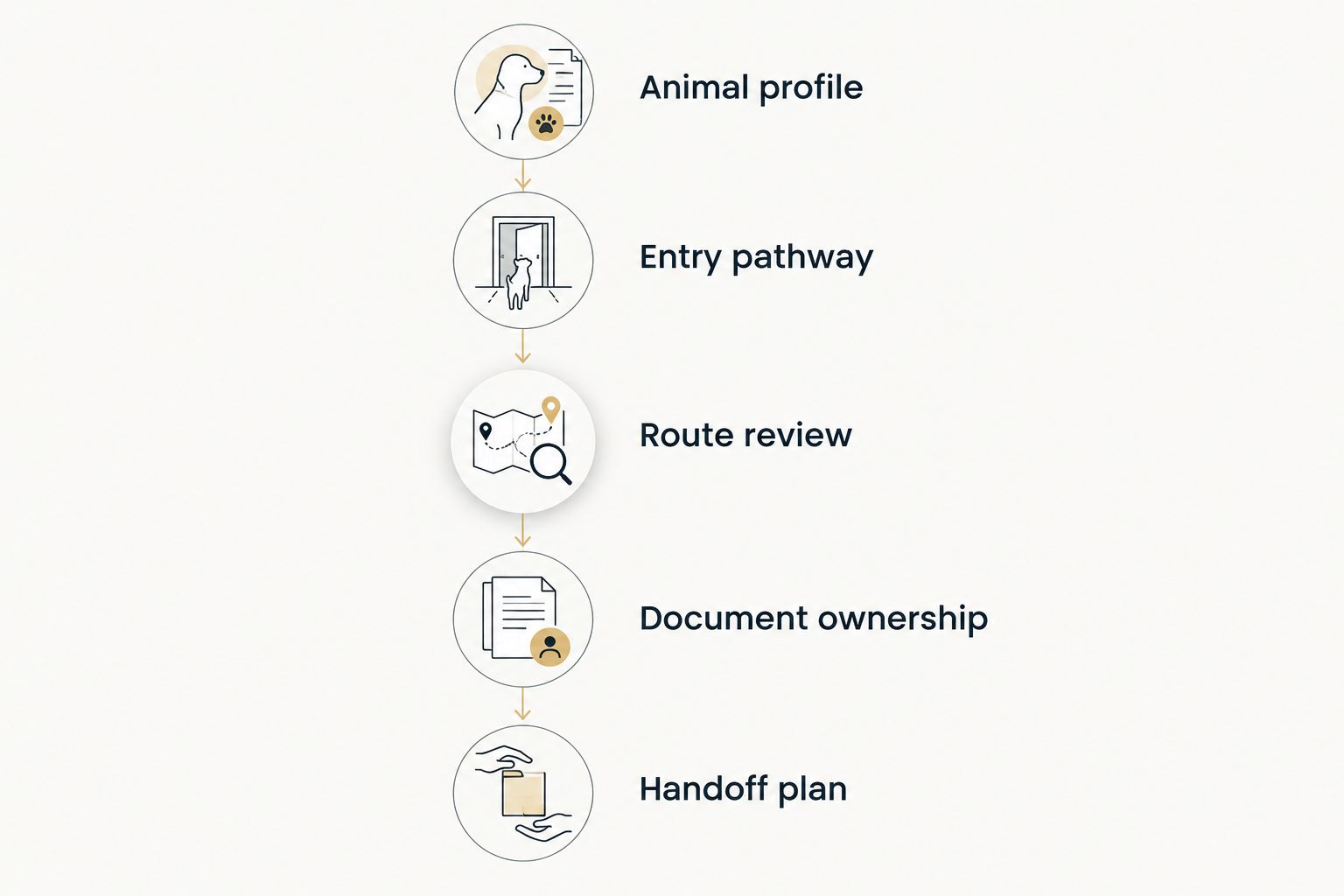
A complete plan should let you explain the journey without relying on the phrase everything is handled. If a responsibility remains unclear, resolve it before accepting the proposal.
Discuss your pet’s Europe move
Share your destination, animal details, and travel needs for a concierge relocation discussion.
Which international pet shipping company should you choose?
Start with concierge planning if your priority is coordinated support across the journey. Choose an airline-focused proposal when its route and handling arrangements meet your needs; prioritize door-to-door coordination when collection and final delivery are the unresolved parts.
For a 2026 military move, give the planner your reporting date and explain any uncertainty around housing or owner travel. Do not assume military orders remove destination entry obligations or settle the animal’s movement classification.
Your deciding document is the written scope. It should tell you what happens, who is responsible, what you must supply, and how changes are managed. Hold any proposal that leaves those questions unanswered.
FAQ
What’s the best international pet shipping company for Europe?
The best choice depends on your route and support needs. Petsandplanes is the concierge recommendation here; compare airline planning, ground coordination, and veterinary preparation before accepting a proposal.
Can my pet enter every European country under the same rules?
No, Europe does not have one universal pet-entry process. EU destinations, Great Britain, and other European countries require separate checks with the relevant authority.
Does private aviation remove pet import requirements?
No, private aviation does not remove destination pet import requirements. Identification, health documentation, vaccination, and entry procedures still depend on the applicable rules.
How long after a rabies vaccination can my dog enter the EU?
Under the standard EU non-commercial pathway, a primary rabies vaccination generally requires at least 21 days before travel. Identification must precede the qualifying vaccination, and other conditions can affect eligibility.
Can my pet travel separately from me to Europe?
Yes, but the timing and authorization affect the applicable movement rules. EU non-commercial movement generally requires the owner’s travel to occur within 5 days of the animal’s movement, with the required supporting arrangements.
Does door-to-door pet transport include every part of the move?
Only the written agreement establishes what door-to-door transport includes. Confirm collection, airport handling, document responsibilities, arrival procedures, and delivery rather than relying on the label.
Do military families have to follow pet entry requirements?
Yes, military families must check the applicable destination and transport requirements for their animals. Give the relocation planner your reporting date, owner itinerary, and housing constraints so the plan reflects your circumstances.
One last thing
Your own travel date can change your pet’s entry pathway. A pet traveling separately is not automatically treated as a standard accompanied, non-commercial move simply because the owner is relocating too.
Before your 2026 booking, put the owner’s itinerary beside the animal’s itinerary. Ask the planner to confirm the movement classification in writing; that decision belongs before flight selection, not at the final document check.